
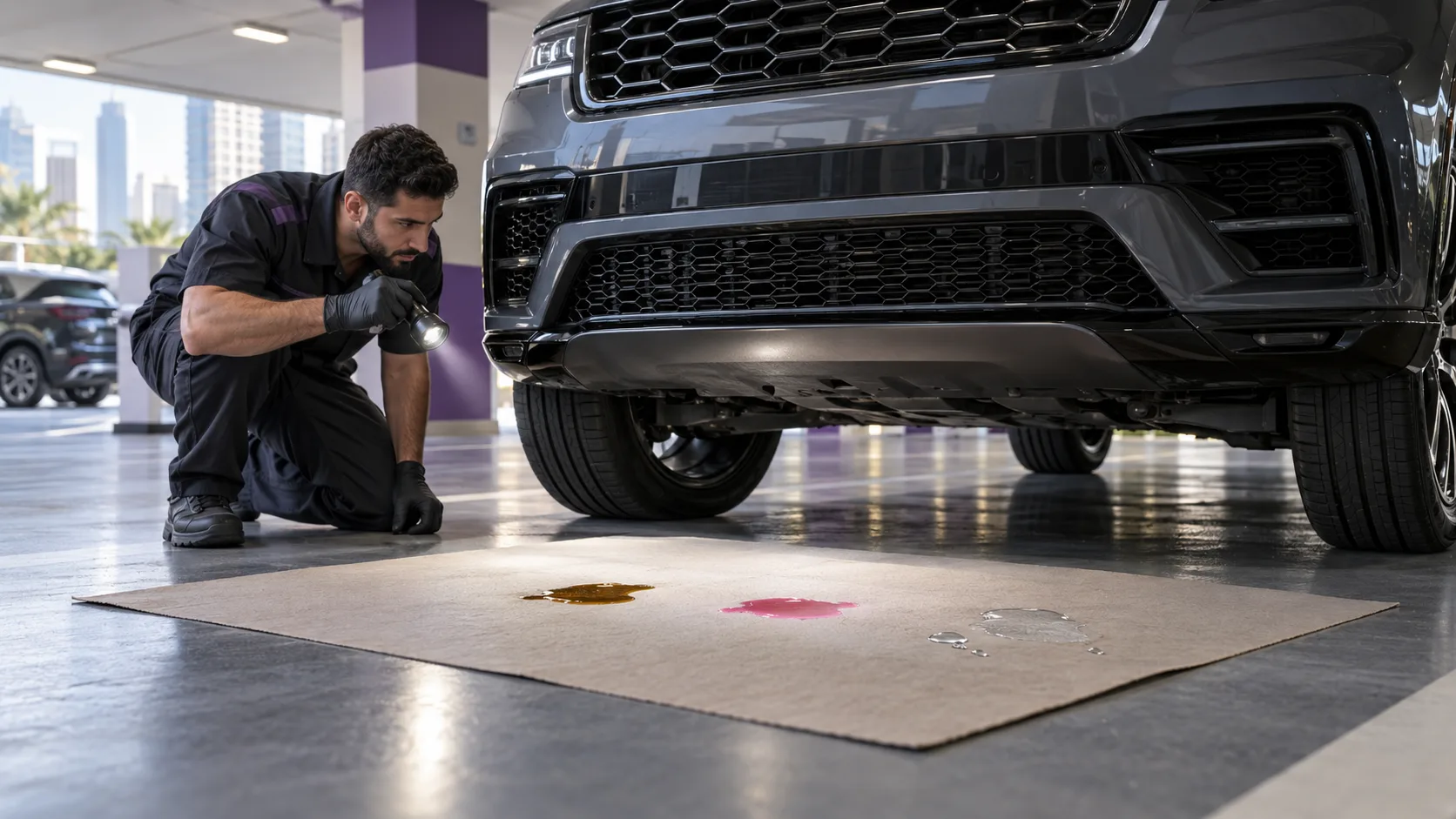
Recognise the pattern
Symptoms that often appear with this problem
- A fresh puddle or repeated drops appear after parking
- The stain is oily, coloured or leaves residue
- Engine oil or coolant level falls between checks
- A low-fluid, oil-pressure, brake, transmission or temperature warning appears
- There is steam, an unusual smell, a soft brake pedal or a change in shifting
- Water collects inside the passenger footwell rather than under the car
Quick identification guide
What could the fluid under your car be?
Appearance and position are only clues. Do not touch an unknown fluid, and use warning lights or changes in braking, temperature and shifting to decide how urgent it is.
| What you notice | Possible fluid | Next step |
|---|---|---|
| Clear, odourless, non-oily water after AC use | AC condensation | Usually normal; check for water inside the cabin |
| Coloured watery fluid or crusty residue | Engine coolant | Check only when cold; stop for heat or steam |
| Amber, brown or black oily stain | Engine oil | Check level; stop for red oil warning |
| Red, pink, amber or brown oily fluid | Transmission or hydraulic fluid | Inspect promptly; do not rely on colour alone |
| Clear to pale fluid near a wheel | Possible brake fluid | Do not drive if pedal or warning changes |
| Strong fuel smell or rapidly evaporating liquid | Fuel | Do not start; avoid sparks and arrange recovery |
Narrow it down
What does the puddle look like—and what changed?
Use appearance only as an initial clue. Warning lights, level changes, pedal feel, temperature and shifting decide the urgency.
Clear water after AC use
Usually normal condensation if it is odourless, non-oily and there are no warnings or cabin leaks.
Coloured watery fluid or dried residue
Possible coolant. Check the cold reservoir level and temperature behaviour without opening a hot cap.
Amber, brown or black oily stain
Possible engine oil. Check the level correctly and stop immediately for a red oil-pressure warning.
Fluid near a wheel plus pedal change
Possible brake hydraulic leak. Do not drive; arrange recovery and inspection.
Strong fuel smell
Do not start the vehicle, smoke or create sparks nearby. Move people away and arrange professional assistance.
Most likely inspection areas
What can cause it?
Normal AC condensation
The evaporator removes moisture from cabin air and drains clear water under the vehicle. After AC use—especially in Dubai humidity—an odourless, non-oily puddle can be normal.
Engine coolant leak
A hose, radiator, expansion tank, cap, thermostat housing, water pump, oil cooler or internal engine fault may allow coolant to escape. Colour alone cannot identify the correct coolant chemistry.
Engine oil leak
Filter housings, drain plugs, sumps, valve covers, oil coolers, turbo lines and crankshaft or camshaft seals are common inspection areas. The highest wet point is often closer to the source than the floor stain.
Transmission or driveline-fluid leak
Transmission, transfer-case or differential fluid can travel along undertrays before dripping. Delayed engagement, slipping, warning messages or a burnt smell increase urgency.
Brake-fluid leak
A leak at a caliper, hose, line, master cylinder or related hydraulic component can reduce braking. A changed pedal, brake warning or fluid near a wheel means do not drive.
Fuel or another hydraulic fluid
A strong fuel smell requires immediate caution. Some vehicles also use hydraulic power-steering fluid, while others use electric steering and have no such reservoir.
Other possible causes
- Washer-fluid leak
- AC drain blocked or disconnected, causing water inside the cabin
- Condensation from the exhaust during warm-up
- Residual fluid after a recent service
- Fluid retained and redirected by an undertray
- Shock-absorber fluid near a wheel
If the symptom is ignored
What can happen if you keep driving?
- Oil starvation and internal engine or turbocharger damage
- Overheating, cylinder-head distortion or head-gasket failure
- Transmission overheating, slipping and internal clutch damage
- Loss of hydraulic braking
- Fire risk from a fuel leak
- Electrical or interior damage when AC water drains into the cabin
How serious is it?
High
The urgency depends on the fluid and accompanying symptoms. AC water can be normal; fuel, brake fluid, a major oil loss, overheating or a rapidly growing puddle can make the vehicle unsafe to start or drive.
Checks and diagnosis
What can you check safely?
- Look at the parking space before moving the vehicle and photograph the puddle with its position relative to the car
- Do not touch, taste or deliberately smell an unknown fluid
- Use clean light-coloured cardboard to record colour, spread and approximate drip position
- Check engine oil on level ground using the exact owner-manual procedure
- Check coolant only when the engine is completely cold; never open a hot pressurised cap
- Read warning messages and note temperature, brake-pedal or shifting changes
- Keep hands, clothing and tools away from belts and electric fans
What requires professional inspection?
- Trace the highest fresh wet point after checking undertrays and airflow paths
- Verify all relevant fluid levels and exact manufacturer specifications
- Cooling-system and cap pressure test where coolant loss is suspected
- Engine oil, filter housing, sump, seals, oil cooler and turbo-line inspection
- Transmission, differential and transfer-case inspection with model-specific level procedure
- Brake hydraulic inspection when fluid or pedal symptoms point there
- UV dye, cleaning and reinspection only when ordinary evidence cannot locate the source
Workshop process
How the cause should be diagnosed
- 1Record the puddle size, colour, texture, timing and parking position
- 2Check warnings, temperature, pedal feel, shifting and recent service history
- 3Inspect above and below the vehicle before cleaning away evidence
- 4Confirm which fluid is actually falling and why its level changed
- 5Pressure-test or use model-appropriate leak-detection methods where required
- 6Repair the confirmed source rather than repeatedly topping up or adding stop-leak
- 7Refill or bleed with the exact specification and verify the repair hot, cold and after a controlled road test
Repair direction
Typical solutions after diagnosis
A symptom alone should not be used to approve parts. Depending on the test results, the repair may include:
- Secure or replace a confirmed hose, clamp, cap, seal or gasket
- Repair a radiator, expansion tank, water pump or thermostat housing after testing
- Correct an oil-filter, drain-plug, oil-cooler, sump or engine-seal leak
- Repair transmission or driveline leaks and set the fluid level by the manufacturer procedure
- Repair and bleed a leaking brake hydraulic system before the vehicle returns to the road
- Clear or reconnect an AC condensate drain when water is entering the cabin
- Use recovery rather than driving when fluid loss or warning symptoms make the vehicle unsafe
Related components
Dubai driving context
Why local conditions matter
High ambient temperature, long idling and constant AC use make clear condensate common, while heat also increases the consequences of low oil or coolant. A puddle pattern is useful evidence, but colour and location alone are not a diagnosis.
Frequently asked questions
Questions drivers ask about this symptom
Is water under the car always a coolant leak?
No. Clear, odourless, non-oily water after AC use is often normal condensate. Coolant loss is more concerning when the liquid is coloured or leaves residue, the reservoir level falls, temperature rises or a warning appears.
Can I identify the leak by colour alone?
No. Different fluids can share colours, and age, dirt or mixing can change their appearance. Use colour only as one clue alongside location, texture, level changes, warnings and professional testing.
Can I drive with a few drops of engine oil?
A few drops are not the same as rapid loss, but a new leak still needs inspection. Check the level correctly and stop if the oil-pressure warning appears, the leak grows or engine noise changes.
Can I open the coolant cap to check the level?
Only follow the vehicle manual and wait until the engine is completely cold. Never open a hot pressurised coolant cap because hot fluid and steam can escape suddenly.
Should I use a stop-leak product?
Do not use one as a substitute for diagnosis. Compatibility and side effects vary, and some products can restrict small passages. Confirm the source and approved repair first.
Why is the puddle not directly below the failed part?
Fluid can travel along an undertray, crossmember, hose or engine surface before falling. Parking slope and airflow can also move the final drip point.
What should I send the garage on WhatsApp?
Send a wide photo showing the puddle position, a close photo on clean cardboard, the vehicle model, when it appeared, warning lights, temperature behaviour, fluid-level changes and any braking or shifting symptoms.
Further reading
Reference material
These links provide background on the systems discussed. They do not replace the owner’s manual or repair information for your exact vehicle. Procedures and test values vary by model.