
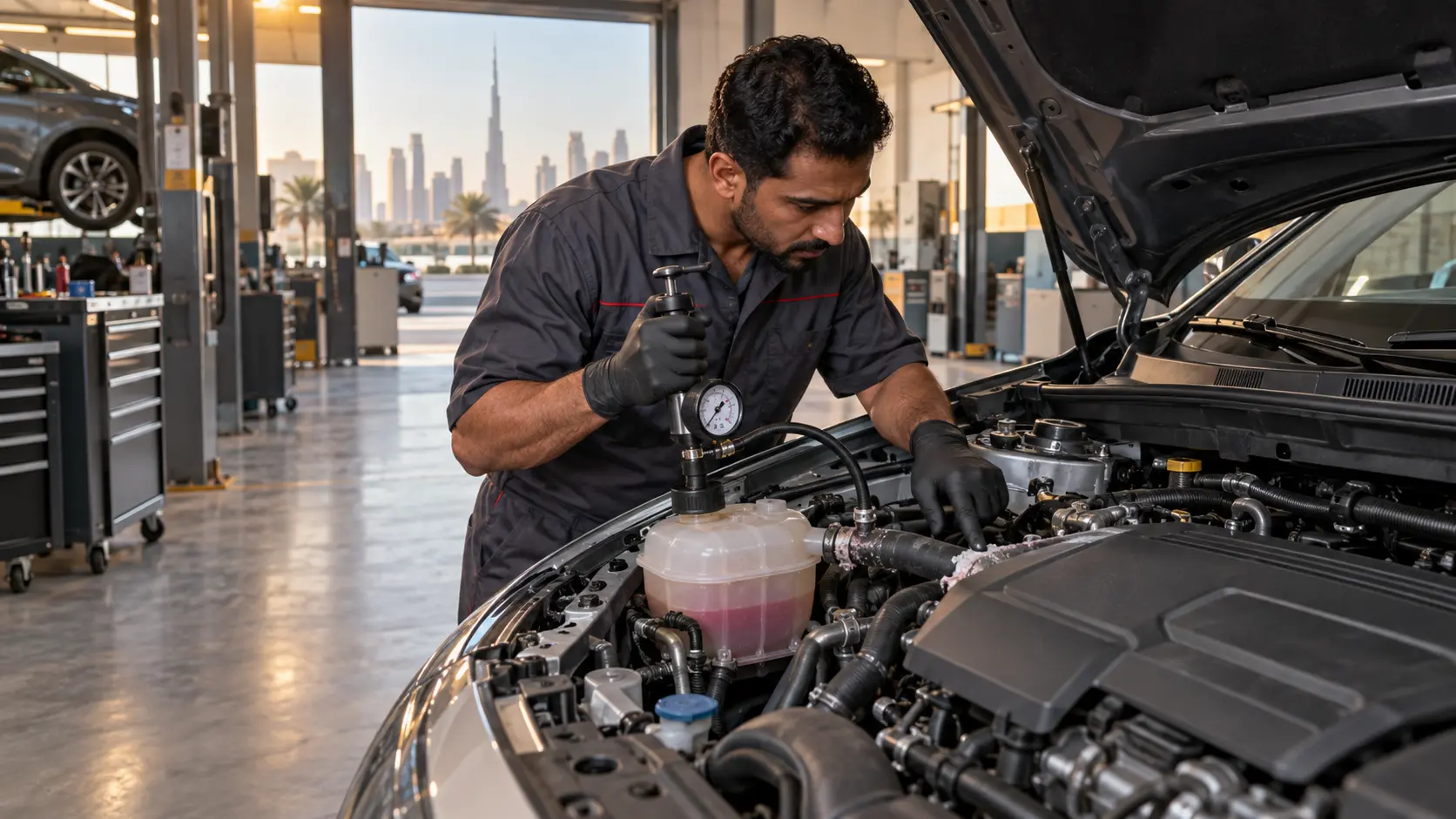
Recognise the pattern
Symptoms that often appear with this problem
- The cold coolant level falls below MIN after being topped up correctly
- A low-coolant warning returns but no puddle appears
- A sweet smell is noticeable after driving or when the heater runs
- Dried coloured or white residue appears around a hose, tank, cap or water pump
- Windows mist unusually or the passenger carpet becomes damp
- White exhaust vapour continues after the engine is fully warm
- The heater output changes or engine temperature rises
Narrow it down
Where can coolant go if the ground is dry?
The absence of a puddle narrows the evidence but does not rule out coolant loss. Smell, residue, cabin symptoms, heat and pressure patterns determine the next test.
No puddle but residue or sweet smell
A hot-only external leak may be evaporating on the engine or collecting behind a cover.
Misting windows or damp carpet
The heater core or cabin coolant circuit moves higher on the inspection list.
White vapour, rough start or abnormal pressure
An internal leak becomes more concerning, but targeted testing is required before condemning the head gasket.
One small change after recent service
Trapped air may have settled; mark the cold level and investigate if it drops again.
Direct answers by driving condition
Can coolant disappear without a visible leak?
Yes. Coolant can escape only when the system is hot, evaporate on hot components, collect behind an undertray, leak into the cabin or be lost internally through the engine or exhaust path. A dry parking space does not prove the cooling system is sealed.
Why does the coolant level drop after driving?
A level that is repeatedly lower after complete cool-down can indicate a pressure-related leak, weak cap, pump leak or internal loss. Compare the level only under the same cold conditions because normal expansion makes hot and cold readings different.
Why is the coolant reservoir empty but there is no puddle?
The reservoir may empty because coolant leaked only while driving, was released as vapour, collected out of sight or was not drawn back correctly as the system cooled. Do not assume the radiator is full; follow the owner manual and have the complete system checked.
Can a bad radiator or expansion-tank cap cause coolant loss?
Yes. A damaged cap seal or pressure/vacuum valve can release coolant too early or prevent correct recovery from the reservoir. Cap testing is inexpensive but must use the correct pressure specification.
Does losing coolant always mean a blown head gasket?
No. Hoses, tanks, radiator seams, caps, pumps and heater circuits are common external causes. A head-gasket or internal fault should be tested when evidence such as persistent white exhaust vapour, combustion pressure, misfire, contamination or unexplained overheating supports it.
Can Dubai heat make coolant disappear?
High ambient temperature increases system load and can expose a weak cap, seal, plastic tank or hot-only leak, but a healthy sealed system should not need frequent coolant top-ups. Dubai heat is a stress factor, not a complete diagnosis.
Why do I smell coolant but cannot see a leak?
A fine hot leak may evaporate before dripping, or the heater core may be leaking inside the HVAC system. Inspect for dried residue, misting windows, damp carpet and traces around the cap, tank, pump, housings and radiator seams.
Safety first
What should I do if my car is losing coolant?
- 1Check the warning and temperature. Stop safely if the temperature is rising, steam appears, power drops or the heater suddenly blows cold.
- 2Allow the engine to cool completely. Do not touch hot hoses, belts or electric fans and do not open any pressurised cooling-system cap while hot.
- 3Record the cold level. On level ground, follow the owner manual and photograph the reservoir level at the same cold condition over several checks.
- 4Look for indirect evidence. Check for dried residue, a sweet smell, damp carpet and fluid retained on the undertray without dismantling hot or moving components.
- 5Use the specified coolant only. Do not mix coolant types by colour alone and do not rely on plain water or stop-leak as a repair.
- 6Book diagnosis instead of repeated top-ups. Pressure, cap, circulation and internal-leak tests identify where the coolant is going before overheating causes secondary damage.
Never open the radiator cap or pressurized coolant reservoir while the engine is hot.
Most likely inspection areas
What can cause it?
A small leak that appears only when hot and pressurised
Cooling-system pressure can open a hairline crack, weak hose connection, radiator seam or thermostat-housing seal only after the engine warms up. The coolant may evaporate before reaching the ground. A sweet smell, fine spray marks or dried residue after a drive are useful clues; a pressure test cold and, where appropriate, after heat cycling helps locate it.
Water-pump seal or housing leak
A pump can leak from its seal, vent or housing mainly while the shaft is turning. Coolant may be thrown onto nearby parts or dry on the hot engine, leaving no driveway puddle. Residue near the pump, bearing noise or coolant traces behind covers require model-specific inspection.
Expansion tank, radiator cap or pressure-cap fault
A cracked tank or cap that cannot hold and recover the specified pressure can release vapour or coolant through the overflow. Staining around the cap, an abnormal reservoir level after cooling or a coolant smell are clues. The cap and tank should be inspected and pressure-tested, never opened while hot.
Coolant trapped by the undertray or engine valley
Modern undertrays can catch fluid and redirect it far from the source. On some engines, coolant can collect beneath intake components before evaporating. Inspection must follow the highest fresh wet point rather than assuming the place where coolant finally drips is the failure.
Heater-core or cabin-circuit leak
A heater-core leak may release coolant inside the HVAC case instead of under the engine. Persistent sweet smell through the vents, greasy window film, unexplained misting or damp carpet are typical clues. Avoid prolonged exposure and arrange inspection because the coolant level can continue falling.
Internal coolant leak into a cylinder, oil or exhaust path
A head-gasket, cylinder-head, block, oil-cooler or other internal fault can consume coolant without an external puddle. Persistent white vapour after warm-up, rough cold start, bubbles, abnormal system pressure, milky contamination or unexplained overheating raise concern, but none alone proves head-gasket failure.
Other possible causes
- Radiator seam or end-tank hairline crack
- Thermostat housing, coolant flange or O-ring leak
- Turbocharger coolant-line leak where fitted
- EGR cooler leak on relevant diesel engines
- Transmission or engine oil-cooler internal leak where coolant passes through it
- Incorrect bleeding after service causing the level to settle
- Incorrect level comparison between a hot and cold engine
- Loose clamp, damaged quick connector or hardened hose seal
If the symptom is ignored
What can happen if you keep driving?
- Sudden loss of coolant and engine overheating
- Cylinder-head or head-gasket damage after overheating
- Oil contamination and bearing damage from an internal leak
- Cabin odour, misting and carpet or electrical damage from a heater-core leak
- Damage to nearby belts, wiring or mounts from repeated coolant spray
How serious is it?
High
A small hidden leak can become a sudden coolant loss, and an internal leak can damage the engine or contaminate oil. Investigate a repeated level drop early; overheating, steam, misfire, contaminated oil or rapid loss makes it urgent.
Checks and diagnosis
What can you check safely?
- Compare coolant only when the engine is completely cold and the vehicle is level
- Photograph the reservoir against MIN/MAX marks to confirm a real trend
- Inspect visible hoses, tank seams, cap area and radiator edges for dried residue
- Check for sweet odour, unusual window film or damp passenger carpet
- Look beneath the vehicle and around undertray edges after parking
- Never open the radiator cap or pressurised reservoir while hot
What requires professional inspection?
- Cold and hot cooling-system pressure test plus pressure-cap test
- Inspection beneath undertrays and in hidden engine valleys
- Water-pump, radiator, tank, housing, hose and heater-circuit inspection
- UV dye only when suitable and ordinary evidence has not located a small leak
- Combustion-gas, leak-down or other internal tests when symptoms justify them
- Oil and coolant cross-contamination checks for relevant cooler or engine faults
Workshop process
How the cause should be diagnosed
- 1Confirm that the cold level is genuinely dropping under consistent conditions
- 2Review recent coolant work, overheating history and the correct coolant specification
- 3Inspect visible residue, cap, tank, radiator, hoses, pump and heater circuit
- 4Pressure-test the system and cap, including heat-related behaviour where safe
- 5Remove or inspect covers only where evidence suggests trapped coolant
- 6Test for internal leakage only after external and pressure checks or when strong symptoms exist
- 7Repair the confirmed source, fill and bleed correctly, then recheck the cold level after controlled heat cycles
Repair direction
Typical solutions after diagnosis
A symptom alone should not be used to approve parts. Depending on the test results, the repair may include:
- Replace a confirmed hose, connector, seal, tank, cap or housing fault
- Repair or replace a leaking radiator or water pump after testing
- Repair the heater-core or cabin cooling circuit and dry affected areas
- Correct the coolant type, concentration and model-specific bleeding procedure
- Repair an oil cooler, EGR cooler or turbo coolant circuit where fitted and proven faulty
- Carry out head-gasket, cylinder-head or internal engine repair only after confirmatory testing
Related components
Dubai driving context
Why local conditions matter
Dubai heat, stop-and-go traffic and continuous AC use keep the cooling system under high thermal load. This can make a marginal cap, plastic tank, seal or pump leak appear only after driving. It does not make frequent coolant loss normal; use the manufacturer-specified mixture and investigate repeated top-ups.
Frequently asked questions
Questions drivers ask about this symptom
How much coolant loss is normal?
A sealed cooling system should not require frequent top-ups. A small one-time change after recent service may be trapped air settling, but a repeatable drop below the cold mark needs investigation.
Can I drive when the coolant is slightly low?
Only consider a short trip if the engine is completely cold, the correct coolant can be restored according to the owner manual, temperature is normal and there are no leaks or warnings. Recovery is safer if the cause is unknown or the level drops again.
Can coolant leak only when the engine is running?
Yes. Pump rotation, heat and pressure can open a leak that is sealed when cold and stationary. That is why inspection after heat cycling and pressure testing can reveal a dry-looking fault.
Does white smoke always mean coolant is burning?
No. Cold-start condensation can produce temporary white vapour. Persistent vapour after warm-up together with coolant loss, sweet odour, misfire or abnormal pressure requires testing for internal coolant entry.
Should I use a coolant stop-leak product?
Do not use stop-leak as a substitute for diagnosis. Compatibility varies and some products can restrict small passages; confirm the source and approved repair first.
How does a garage find a hidden coolant leak?
A proper diagnosis confirms the cold level, inspects residue and hidden areas, pressure-tests the system and cap, checks heater and pump circuits, and uses internal-leak tests only when the evidence supports them.
When is coolant loss an emergency?
Stop driving for rising temperature, steam, rapid loss, repeated warning, cold heater output while temperature rises, severe power loss, rough running or contaminated oil. Arrange recovery instead of adding more coolant and continuing.
Further reading
Reference material
These links provide background on the systems discussed. They do not replace the owner’s manual or repair information for your exact vehicle. Procedures and test values vary by model.