
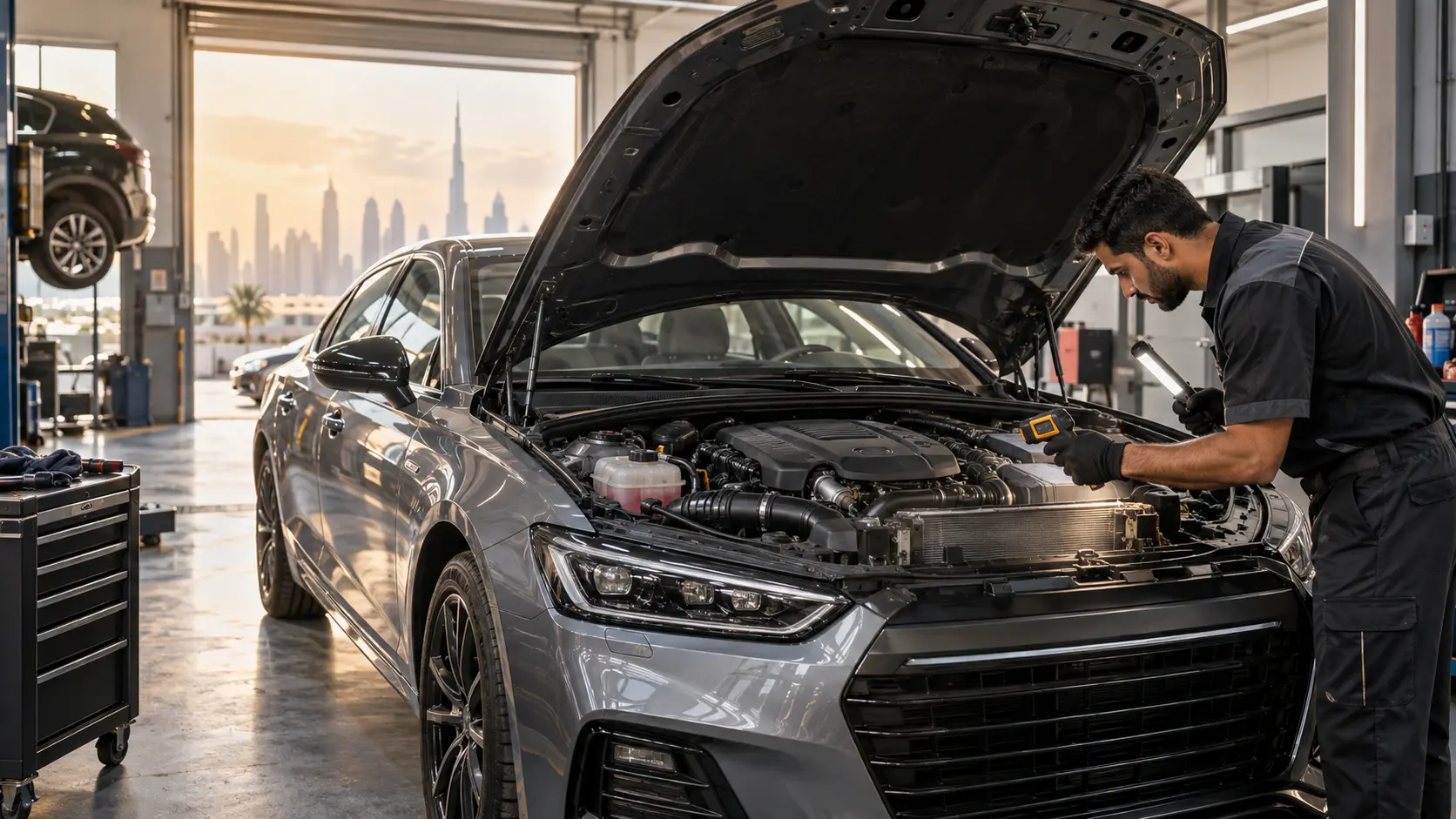
Recognise the pattern
Symptoms that often appear with this problem
- Temperature gauge rises above its normal stable position or enters the red zone
- A red temperature or coolant warning appears
- Steam or coolant vapour comes from under the bonnet
- Sweet coolant smell, visible leakage or repeated coolant loss
- Cabin heater suddenly blows cold while engine temperature rises
- Loss of power, rough running or unusual cooling-fan behaviour
- Temperature rises in traffic, at idle, with AC on or under sustained load
Narrow it down
The driving pattern helps narrow the cause
When temperature rises is often more useful than the warning alone. These patterns guide testing but do not replace measurement.
Hot mainly at idle or in traffic
Prioritise low-speed airflow, fan operation and fan controls, then confirm coolant level and circulation.
Hot at highway speed or under load
Coolant loss, pump/thermostat flow, radiator restriction, pressure loss or an internal engine fault move higher on the inspection list.
Gauge changes but measured temperature is normal
Sensor, wiring, cluster or data interpretation may be involved. Confirm actual coolant temperature before replacing cooling parts.
Direct answers by driving condition
Why does my car overheat in traffic?
Overheating mainly in traffic usually points first to insufficient low-speed airflow, although low coolant and poor circulation remain possible. Because road speed is low, the radiator depends on its electric or engine-driven fan.
- Check whether AC cooling also becomes weak at idle
- Fan motor, relay, module, wiring and temperature commands require testing
- Blocked fins or debris between the condenser and radiator can reduce airflow
Why does my car overheat while idling?
A car that overheats while idling often has a fan or airflow problem, but a weak water pump, trapped air, low coolant or radiator restriction can behave similarly. The fan running does not prove that it is moving enough air.
Why does my car overheat when stopped but cool down while driving?
Movement forces air through the radiator, so this pattern strongly raises suspicion of a low-speed fan or airflow fault. It does not by itself prove the fan motor is bad; fan speed, shroud, condenser blockage, coolant level and circulation still need checking.
Why does my car overheat when the AC is on?
The AC adds engine load and heat at the condenser, and it normally commands additional fan airflow. Overheating with AC on can expose a weak fan, airflow restriction, marginal radiator, cooling-system fault or an AC pressure/control problem.
Why is my car overheating even though the coolant is full?
A full reservoir proves only that coolant is present at that location. The engine can still overheat if coolant is not circulating, the radiator cannot reject heat, the fan fails, pressure is lost, air is trapped or combustion gas enters the system.
Why does my engine temperature go up and down?
A fluctuating gauge can come from changing coolant flow, trapped air, low coolant, an intermittent fan, thermostat operation or a sensor/wiring fault. Treat an actual rise with heater changes, warning messages or coolant loss as overheating until tested.
Why does my car overheat and then return to normal?
Intermittent fan control, a thermostat that sticks, an air pocket or changing vehicle speed/load can let temperature rise and then fall. Returning to normal is useful diagnostic evidence, not proof that it is safe to ignore.
Why does my car overheat at highway speed?
At highway speed there is already strong airflow, so coolant loss, poor circulation, a restricted radiator, thermostat or pump fault, combustion-gas leakage or unusually high engine load move higher on the list. Reduce speed and stop if temperature continues rising.
Why is my car overheating without a visible coolant leak?
Some leaks appear only when hot, evaporate on engine parts, stay inside an undertray or occur internally. The system can also overheat with no leak because of fan, thermostat, pump, radiator, pressure or sensor faults.
Can hot Dubai weather cause a car to overheat?
Dubai heat increases the cooling system's workload, especially in traffic with the AC running, but a healthy system should control engine temperature within its designed range. Overheating in summer usually exposes low coolant, restricted airflow, weak components or another fault rather than heat being the only cause.
Can I continue driving if my engine is overheating?
No—continuing to drive while temperature is rising is not recommended. Stop safely and arrange recovery when there is steam, a warning, leakage, severe power loss, a red or rapidly rising gauge, or repeated overheating.
Safety first
What should I do immediately if my car starts overheating?
- 1Move out of danger. Signal, reduce load and pull over in a safe place away from traffic. Turn on the hazard lights and select Park or Neutral with the parking brake applied.
- 2Switch off the AC. If you still need a brief moment to reach a safe stopping point and there is no steam, maximum cabin heat may draw away some heat. It is not a repair and should not be used to continue the journey.
- 3Stop the engine when safely parked. Do this immediately for steam, coolant escaping, a rapidly rising/red gauge, warning message, severe power loss or abnormal noise. Stand clear of steam and traffic.
- 4Let the vehicle cool completely. Do not touch electric fans, belts, hot hoses or pressurised cooling-system parts. An electric fan can start without warning.
- 5Check only when cold. Follow the owner manual. Look for visible leaks and check the expansion-tank level without opening a hot system. Do not add cold liquid to a severely hot engine.
- 6Arrange inspection or recovery. Recover the vehicle if coolant is missing, leakage or steam is present, the fan is not operating when commanded, temperature rises again or the cause is unknown.
Never open the radiator cap or pressurized coolant reservoir while the engine is hot.
Most likely inspection areas
What can cause it?
Low coolant or an external coolant leak
Too little coolant leaves parts of the engine without reliable heat transfer. Hoses, radiator seams, the expansion tank, thermostat housing, water pump, heater core and connections can leak only when hot and pressurised. Falling cold level, dried residue, a sweet smell or a puddle are clues. Steam, rapid loss or a rising gauge requires an immediate stop.
Cooling fan, relay, module or control fault
At idle and in slow traffic the fan must pull air through the condenser and radiator. A failed motor, fuse, relay, control module, wiring fault or missing temperature command may therefore overheat the car while it cools normally at road speed. It is urgent if temperature keeps rising; electric fans can start unexpectedly, so hands must stay clear.
Thermostat stuck closed or operating incorrectly
A closed thermostat can trap hot coolant in the engine instead of sending it through the radiator. Fast temperature rise, poor radiator heat distribution or repeated spikes can fit this pattern, but scan data and temperature measurements are needed because low coolant and air pockets can look similar.
Water-pump or coolant-circulation failure
A loose or damaged impeller, bearing failure, drive problem or electric-pump fault reduces coolant flow. Clues can include a leak or noise near the pump, weak heater output, overheating under load or a stored pump fault. Do not keep driving when circulation is doubtful.
Radiator restriction, damage or weak heat rejection
Internal deposits can restrict coolant tubes; external sand, debris or bent fins can restrict air. A partially blocked radiator may fail at highway load even though the fan works. Temperature mapping, flow evidence and inspection help distinguish it from a pump or thermostat fault.
Pressure-cap or expansion-tank cap fault
The specified cap helps the system maintain pressure and manage coolant expansion and return. A damaged seal or valve can allow early boiling, overflow or poor coolant recovery. Staining around the cap or a reservoir that behaves abnormally is a clue, but the cap should be pressure-tested and never opened hot.
Air trapped in the cooling system
Air can interrupt circulation, create hot spots and make heater output or the gauge fluctuate, especially after cooling-system work or coolant loss. Correct model-specific filling and bleeding is required; repeated air entry means the underlying leak or combustion-gas source must also be found.
Head-gasket failure or another internal coolant leak
Combustion gas can pressurise the cooling system, while coolant may enter a cylinder or the oil system without an obvious puddle. Persistent bubbles, unexplained coolant loss, white exhaust vapour after warm-up, misfire, contaminated oil or hoses becoming abnormally hard are clues—not proof. Pressure, combustion-gas, cylinder and oil/coolant tests are used to confirm it.
Other possible causes
- Blocked coolant passage or collapsed hose
- Damaged or slipping water-pump drive belt where the design uses one
- Faulty coolant-temperature sensor, wiring or gauge indication
- Incorrect coolant mixture, incompatible coolant or contamination
- Condenser/radiator airflow restriction
- Fan shroud damage or incorrect previous repair
- Engine load, ignition or combustion problem adding abnormal heat
- AC system pressure or fan-command problem adding load at low speed
If the symptom is ignored
What can happen if you keep driving?
- Coolant boiling and sudden coolant loss
- Cylinder-head distortion or head-gasket damage
- Oil breakdown and bearing, piston or turbocharger damage
- Catalyst damage after misfire or coolant entry
- Complete engine failure after severe or repeated overheating
How serious is it?
Urgent
Continuing to drive while temperature is rising can turn a fan, hose or thermostat fault into cylinder-head, head-gasket or complete engine damage. Steam, coolant loss, severe power loss or repeated overheating requires recovery rather than another test drive.
Checks and diagnosis
What can you check safely?
- Read the temperature warning and note whether the change occurs at idle, in traffic, with AC on or at highway speed
- After complete cooling, inspect the ground, hoses, radiator, reservoir and cap area for leakage or dried residue
- Check only the cold coolant level using the owner-manual procedure and correct specification
- Notice whether cabin heat turns cold as engine temperature rises
- Do not put hands near fans or belts and do not perform roadside electrical bypasses
What requires professional inspection?
- Cooling-system and cap pressure testing, including hot-only leaks
- Fan command, actual fan speed, relay/module, fuse, wiring and sensor data
- Radiator inlet/outlet temperature distribution, airflow and internal/external restriction
- Thermostat opening and water-pump circulation using model-appropriate tests
- Correct filling, vacuum fill or bleeding procedure and coolant concentration
- Combustion-gas, cylinder leak-down or other internal-leak tests when evidence supports them
Workshop process
How the cause should be diagnosed
- 1Confirm whether the engine is genuinely overheating using scan data or measured temperature
- 2Record whether the fault occurs at idle, in traffic, with AC, at speed or under load
- 3Inspect cold coolant level, condition, leaks, cap and previous repair history
- 4Command and test fans and airflow rather than assuming that visible rotation is sufficient
- 5Measure thermostat, pump and radiator temperature/flow behaviour
- 6Pressure-test the system and cap; bleed correctly if air is present
- 7Test for internal leakage only when symptoms or prior results justify it
- 8Verify stable temperature at idle, with AC and on a controlled road test after repair
Repair direction
Typical solutions after diagnosis
A symptom alone should not be used to approve parts. Depending on the test results, the repair may include:
- Repair the confirmed hose, radiator, tank, housing, pump or other leak and refill with the specified coolant
- Repair the fan motor, relay, controller, fuse, wiring or sensor fault proven by testing
- Replace a thermostat, pressure cap, water pump or belt only when operation is confirmed faulty
- Clean or replace a restricted or damaged radiator/condenser as evidence requires
- Remove trapped air with the correct filling/bleeding procedure and find why air entered
- Repair an internal engine or head-gasket fault after confirmatory tests
Related components
Dubai driving context
Why local conditions matter
High ambient temperature, stop-and-go traffic, long idling and continuous AC use reduce the cooling system's spare capacity. Use the manufacturer-specified coolant type and mixture, keep heat exchangers unobstructed and investigate any temperature change early. Plain water or an improvised mixture may reduce corrosion, boiling and freeze protection compared with the specified coolant.
Frequently asked questions
Questions drivers ask about this symptom
What should I check first when my car overheats?
First stop safely and let the engine cool completely. Then check warning messages, the cold coolant level and visible leaks; do not open a hot pressurised cap or place hands near an electric fan.
Can low coolant cause overheating?
Yes. Low coolant can interrupt heat transfer and create air pockets, but repeated topping-up is not a repair—the reason for coolant loss must be found.
Can a bad radiator fan make the car overheat only in traffic?
Yes. Low-speed overheating that improves while moving is a common fan/airflow pattern, although coolant level, radiator condition and circulation must still be tested.
Does a full coolant reservoir rule out a leak?
No. A leak may occur only under pressure, evaporate, collect under a cover or be internal; the reservoir can also appear full while another part of the system contains air.
How is an overheating problem diagnosed?
Diagnosis confirms actual temperature, reproduces the driving pattern, checks level and leaks, tests system pressure and cap, commands the fans, measures radiator/thermostat/pump behaviour and tests for internal leakage only when indicated.
Can I add water and keep driving?
Do not open or refill a hot pressurised system and do not use water as permission to continue driving. After full cooling, follow the owner manual and use the specified coolant; recovery is safer when there is leakage, steam, repeated overheating or an unknown cause.
When should I take the car to a garage?
Arrange inspection after any genuine overheating event, repeated temperature fluctuation or unexplained coolant loss. Use recovery rather than driving if the warning returns, coolant leaks, steam appears or the engine loses power.
Further reading
Reference material
These links provide background on the systems discussed. They do not replace the owner’s manual or repair information for your exact vehicle. Procedures and test values vary by model.